
Although the Association of Certified Fraud Examiners (ACFE) has existed since 1985, the profession of Certified Fraud Examiner (CFE) is still relatively unknown. In circumstances that may involve fraud, the public turns to Auditors and Forensic Accountants more often than CFEs. These roles overlap in some areas, but each specialty has unique roles. Just like you would not go to a cardiologist about a bad knee, knowing who to turn to when you suspect you are a victim of fraud is crucial.
Auditors
An auditor’s main role is compliance, to identify the risk of misstatement in audit documents. This is emphasized in audit opinion letters that state the auditor’s responsibilities are “to identify and assess the risks of material misstatement, whether due to fraud or error” (Reporting Implications of the Canadian Auditing Standards (CAS) 4th Edition, 2019).
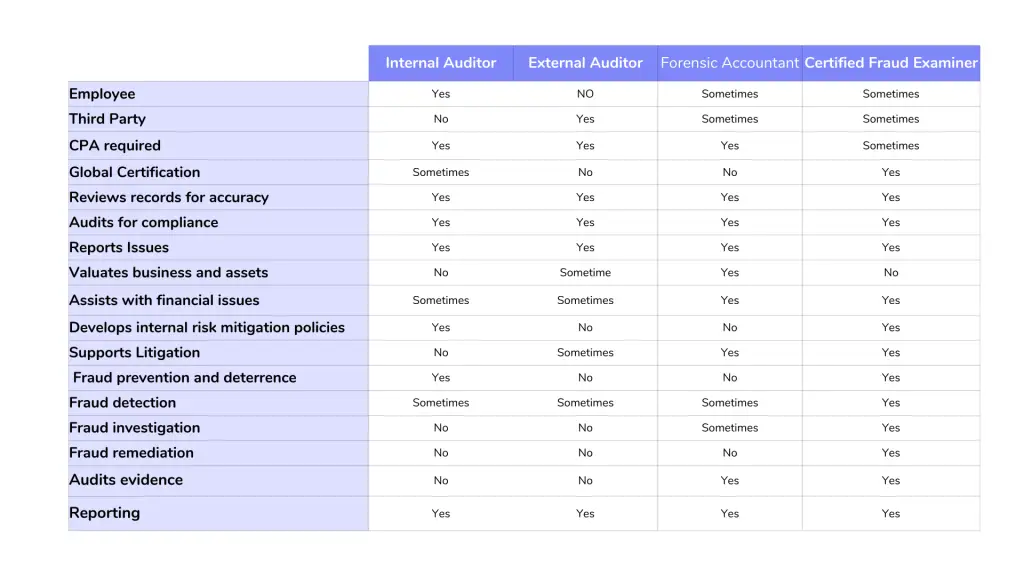
Additionally, external and internal auditors have exclusive roles. While external auditors are third-party and regionally certified, internal auditors are employees and are globally certified if they are Certified Internal Auditors. However, as the focus of an audit is primarily compliance, auditors may not detect fraud. The ACFE 2024 Report to the Nations states that internal auditors initially detected 14% of reported fraud, and external auditors detected 3% of reported fraud. (pg 24)
Forensic Accountants
Like auditors, forensic accountants are Certified Public Accountants (CPA) and can be internal or external to the company. They review records, audit for compliance, and do reporting. Forensic accountants also provide business and asset valuations and assist with financial issues. A key role for forensic accountants is their litigation support. Both auditing and forensic accounting are specialties in accounting.
Certified Fraud Examiners
CFEs can be internal or external to a company. The designation includes law enforcement, insurance, financial services, government, manufacturing, accounting, and other industry professionals. The diversity of backgrounds is helpful as not all fraud happens in a corporate setting, nor is all fraud financial. For example, fraud also includes bribery, corruption, real estate, and forgery.
CFEs review records, audit for compliance, and report issues like auditors and forensic accountants. They develop internal risk mitigation strategies and are globally certified. As with forensic accountants, CFEs assist with financial problems, support litigation, and investigate fraud. These professionals are unique in their role in fraud remediation.
When choosing an anti-fraud professional to assist you or your company, understanding the differences between a CFE, an auditor, and a forensic accountant can significantly benefit the outcome.
Kathleen O’Donoghue, CFE
Leave a Reply