
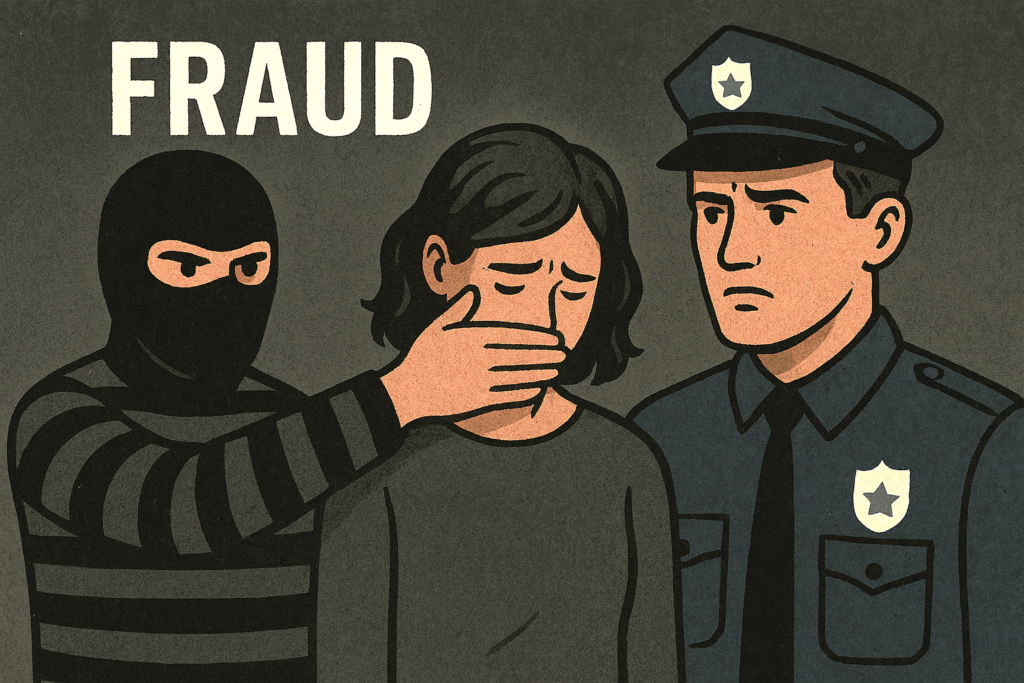
I started my anti-fraud journey wanting to know more about how fraud is perceived in our society, why its true impact on people and organizations is minimized, and my role in fighting fraud. Some of it had to do with places that I worked that were victims of fraud. In one case, an employee made fraudulent entries to hide the cash she had taken. The company let her go without charging her. She has since been convicted of fraud multiple times. Did the company’s silence allow her to continue her crimes?
The other instance was more heartbreaking for me. A company hired me to replace a contractor who had been doing the work. She was a friend of the ownership team, someone they trusted. She used fake invoices and other fraudulent accounting entries to take over $60,000 from the company. In this case, the woman was charged with fraud over $5,000, dragged out the legal process, and only pleaded guilty right before the trial was set to start. She was sentenced to 90 days, served on weekends, and was to pay restitution – she didn’t.
These two cases made me want to learn more about fraud and “white collar crime”. I took courses to understand the nuances and how the Canadian government and law enforcement protected Canadians. Later, I became a Certified Fraud Examiner (CFE) to better understand the many ways fraud can occur and to recognize that the term “white collar crime” minimizes what fraud really is. My training helped me better understand how much bad actors rely on society’s silence or dismissal of their actions as less intentional and therefore less harmful than they are.
When fraud is minimized or dismissed, our silence becomes the fraudster’s tool.
My understanding of fraud became clear. Fraud is an umbrella term for when one party deliberately misleads another party, so that the first party can benefit from the deception. The benefit isn’t always a financial gain; it can be as small as tickets to an event and as big as getting a child into a school. It is so prevalent in our society that every industry, every individual is a potential victim. I gained clarity into why fraud is minimized and why its negative impact is so often dismissed.
By becoming a CFE, I learned about the different types of fraud schemes, from credit card, mortgage and health care fraud to corruption, conflicts of interest, and bribery, as well as the laws that exist to combat them. I became knowledgeable about ethics in government and business, and the importance of the role of Ethics Commissioners.
Government fraud became a focus for me as I watched the people elected to run our cities, provinces and countries bend the rules to suit themselves, and the commissioners who were supposed to hold politicians accountable had no power to do so. The issue was not just actions, but the lack of consequences for those actions, reinforcing how easily fraud can be dismissed. The more I learned, the more passionate I became about fighting fraud.
When a victim’s shame keeps them quiet, the fraudster is protected against prosecution.
Fraudsters prey on the vulnerable, the overly confident, and those who don’t understand terminology or language. They look for weaknesses in our society and systems and exploit them. They carry out their crimes in ways that make the victims reluctant to come forward, to admit that their trust was misplaced. Reinforcing the reluctance to speak out, often by telling the target they cannot tell anyone, or that they have been specially chosen, is another way fraudsters silence their victims.
Fraud can occur between strangers, within a friend group, or miles away from the victim. The fraudster can be a single individual working independently, part of a coordinated effort within a larger group, or part of organized crime. The proceeds of fraud are used to finance individuals’ lifestyles, conceal other illegal acts, or support organized crime.
March is International Fraud Awareness Month. Global efforts are being made to shine a light on how fraud can occur, how people can protect themselves, and to encourage people to come forward – even if the fraud attempt has been unsuccessful. It is only when people come forward that law enforcement can justify allocating resources to fight fraud, and only when they speak to their political representatives that laws can be strengthened to deter fraud.
Kathleen O’Donoghue, CFE
Leave a Reply